Explore insider threat prevention strategies that balance access controls with usability.

November 18, 2026
Tightening employee access after an insider threat scare often increases risk by pushing work to unmonitored channels. Over-restriction can widen your exposure instead of reducing it.
When an employee runs into a locked file or a denied request, the instinct is rarely to file a ticket and wait. More often, it's to find another way through: a personal inbox, a phone camera, a free cloud account nobody in IT has ever heard of.
That workaround is where insider threat prevention quietly starts to fail.
Locking down systems feels like the safest move in the moment, but the tighter the lockdown, the more it pushes people toward paths nobody is watching. Boxed-in employees improvise, and improvisation tends to run through personal devices and unapproved apps rather than through anything a security team can see.
The goal of insider threat prevention is to protect sensitive data and reduce risk, so the method matters as much as the intention. Applied carelessly, access controls can undermine the very outcome they're meant to produce, which is why the real impact of over-restriction deserves as much attention as the threat it's meant to stop.

A scare tends to trigger the same reflex: tighten permissions across the board, for everyone, all at once. The trouble shows up once those controls get tighter than the work can tolerate.
When employees lose access to the tools or data their jobs require, output slows first. Then comes the harder problem: people start routing around the restriction, reaching for personal email, cloud storage, or messaging apps just to keep moving.
None of those shadow channels sit inside a security team's view. Once sensitive information moves through them, it has effectively left the protected environment, and detecting insider threats or tracing data loss gets far harder.
So the restriction meant to shrink insider risk ends up relocating it, into places detection tools were never built to reach. The attack surface widens, and both the accidental slip-up and the deliberate act gain more room to happen unnoticed.
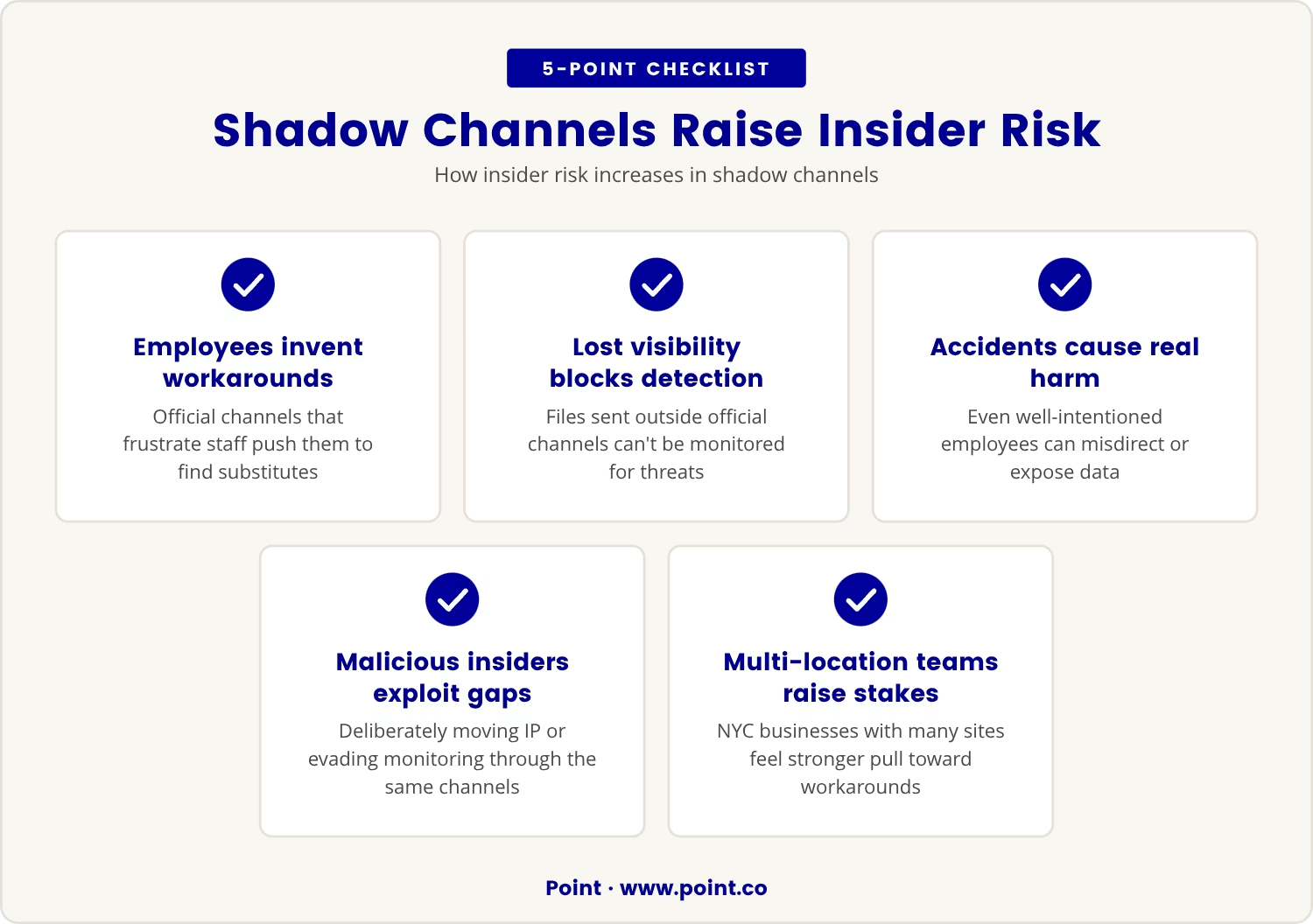
Once official channels turn into obstacles, employees invent their own routes for sharing files or messaging coworkers. That substitution is precisely what drives insider risk higher.
Personal devices and apps sit outside organizational control by definition. A file sent through personal email or dropped into a private cloud account takes visibility with it, and without visibility there's no real way to detect insider threats moving through it.
Even a well-intentioned employee can do damage this way, sending data to the wrong recipient or parking it somewhere insecure. Malicious insiders exploit the same gaps deliberately, using them to move intellectual property or slip past monitoring altogether.
In New York City, where many businesses run multiple locations and teams at once, the pull toward quick workarounds only gets stronger. The more fragmented the systems, the harder insider risk becomes to manage across all of them at once.
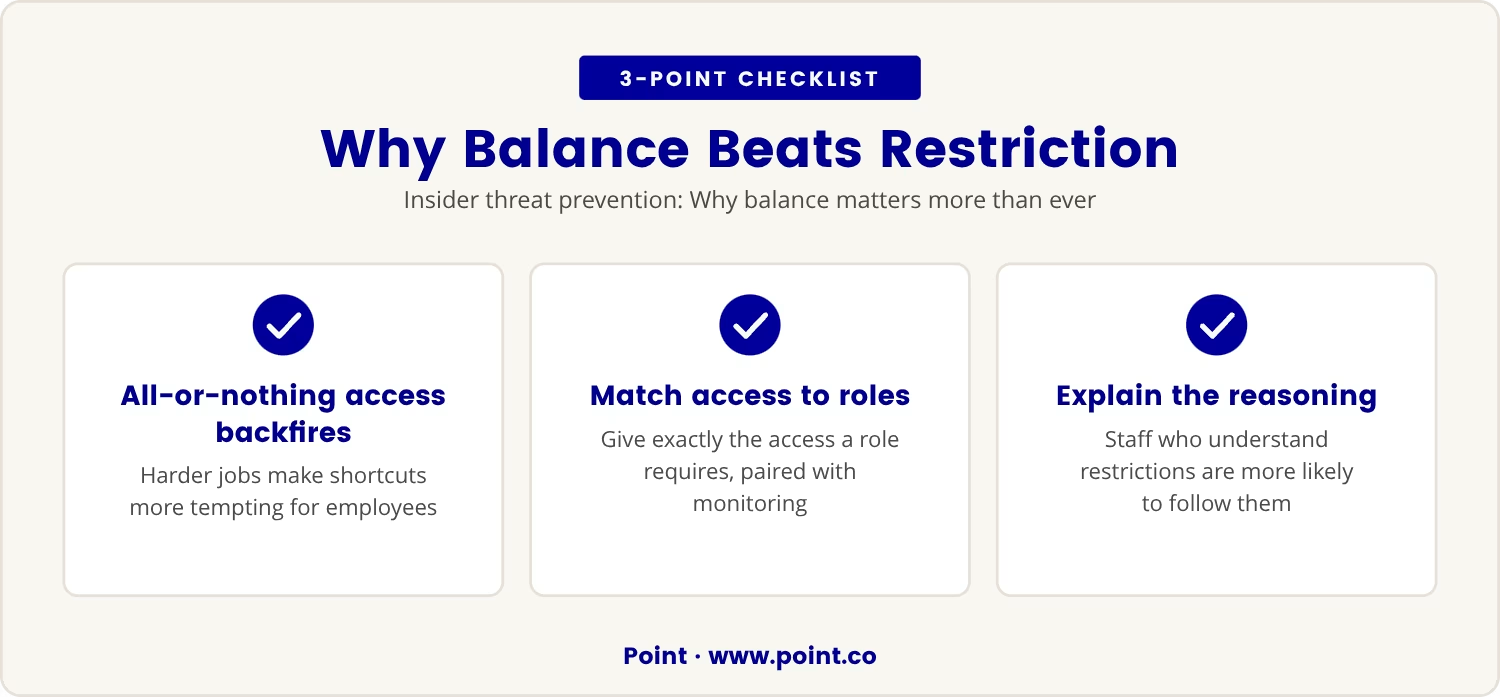
Security teams default to limiting access, but genuine insider threat prevention rests on balance rather than restriction alone. An all-or-nothing approach tends to backfire in the same way: by making the job harder, it makes the shortcut more tempting.
When employees can't do their jobs without friction, they route around the friction. That is why effective insider threat prevention means giving people exactly the access their role requires, no more and no less, paired with monitoring for the behavior that falls outside that norm.
Privileged access management narrows who can reach sensitive data, but it only holds up alongside user activity monitoring and security policies people actually understand. Staff who grasp the reasoning behind a restriction are far more likely to work within it rather than around it.
That balance isn't a one-time setting. Reviewing permissions regularly and adjusting them as roles shift keeps access aligned with need, which is what prevents insider threats without driving work into unmonitored corners.
Tightening access looks like a fast fix, but the bill arrives in forms that don't show up on the first day.
Building an insider threat program that doesn't drive users underground means getting several pieces working together rather than leaning on restriction alone, a question many organizations in NYC are actively working through. Here are the elements that make it hold up.
Explain security policies in plain language, so everyone understands what's expected and why restrictions exist.
Give employees only the access they need for their roles, and review permissions regularly to keep them up to date.
Monitor for unusual behavior, such as large file transfers or access to sensitive data at odd hours, to detect insider threats early.
Provide regular training so staff recognize insider threat indicators and know how to report concerns safely.
Have a clear plan for responding to insider attacks, including steps for containment, investigation, and recovery.
Use detection methods and threat detection tools that work together, so risks become visible across every channel, not just the official ones.
An insider scare makes locking everything down feel like the obvious next move. Before making sweeping changes, though, it's worth asking: will these controls help staff do their jobs, or will they push them toward the same workarounds that caused the problem in the first place?
A measured response targets the root cause rather than the symptom. That means examining how the breach actually happened, which insider threat indicators got missed along the way, and which changes would genuinely sharpen insider threat detection rather than just adding friction.
Involving staff in that process matters just as much. When employees see how a new control protects sensitive data without making their work impossible, bypassing it stops being the path of least resistance.
Tightening controls right after an insider threat is a natural impulse, but acting on it without care tends to create more problems than it solves. Over-restriction pushes work into unmonitored channels, and that is exactly what makes insider threats harder to detect and prevent.
The programs that hold up over time balance security with usability instead of choosing one over the other. Clear policies, regular reviews, and open communication protect the organization without opening a second, less visible front of risk.

Many organizations with 15 to 200 users—especially those scaling past 40—face the challenge of securing sensitive data without slowing down their teams. At Point , we understand how easy it is to overcorrect after an insider threat scare, only to create new risks in the process.
If you want to see how we help businesses like yours balance security and usability, let’s talk about your current approach and where it could be improved.
Qualifying organizations can receive up to $5,000 in free network upgrades, making it easier to secure your systems as you address insider threats.
Watch for shifts in user behavior: accessing files outside someone's normal scope, downloading unusually large volumes of data, or logging in at odd hours. These insider threat indicators can point to accidental mistakes as much as deliberate harm. Alerts built around these actions, reviewed on a regular schedule, catch problems while they're still small.
Malicious insiders act with intent, stealing intellectual property or leaking sensitive information on purpose. Negligent insiders cause harm without meaning to, mishandling data or skipping security policies out of carelessness rather than malice. Both can lead to a data breach, but because the motivations differ, so do the strategies for preventing each one.
Apply the principle of least privilege: give employees only the access their role actually requires. Review and adjust those permissions as responsibilities change, and bring staff into the conversation so they understand why certain restrictions exist. That understanding keeps sensitive data protected without making people feel locked out of their own work.
Data loss prevention tools give visibility into how sensitive information gets shared or transferred. Paired with regular staff training, clear security policies, and ongoing user activity monitoring, they close most of the common gaps. Encouraging employees to report suspicious behavior, and making it easy to ask questions about security closes the rest.
Growth tends to outpace controls unless someone is actively managing that gap, so insider risk rises as a business scales. Assigning clear roles for threat response, investing in technology that covers detection across every channel, and reviewing the security strategy on a regular cadence keeps pace with that growth. The team also needs the resources and authority to adapt as the organization keeps changing shape.