
Discover how cybersecurity for small business impacts growth. A weak credential policy can delay deals and hinder opportunities. Learn effective practices.

November 12, 2026
A single weak credential policy can stall mergers or funding rounds for small businesses, even after a breach is resolved. Due diligence reviews often uncover these issues, delaying growth plans regardless of whether an attack ever happened.
Most people assume that once a data breach is contained, the business problem is contained too. In practice, the fallout keeps working against you long after the technical fix: deals stall, partnerships pause, and growth plans sit on hold while everyone sorts out what the incident means.
That lag has a root cause, and it's often something as small as a loose password rule. A single weak spot in how credentials are managed can create headaches that outlast the incident that exposed it, so the effects of a resolved breach can linger in ways you might not expect.
Small businesses in New York City carry this risk especially sharply, since they face the same digital threats as larger firms but with fewer resources to absorb the aftermath. Protecting your business, then, isn't just about stopping hackers in the moment; it's about keeping your company's future plans intact. If you're aiming for growth, funding, or a merger, your security practices will land under the microscope, which is exactly why the hidden consequences of weak credentials deserve a closer look.

A credential policy is the set of rules that decides how your team creates and manages passwords and access, and while it might sound like a small operational detail, it can carry outsized weight with your business's reputation and opportunities.
Investors and potential partners reviewing your company look closely at exactly this kind of practice. If they find password rules that are too simple or inconsistently enforced, it raises concern even when you've never had a major breach, and that concern rarely stays quiet. It tends to surface as more questions, additional audits, and longer delays, so a weak credential policy can make your business look like a riskier bet than it actually is, slowing or even derailing deals that otherwise had momentum.
Due diligence is the process where outside parties, such as investors or buyers, examine your business before committing to a major decision, aiming to confirm that your company is safe to work with and that their money is protected.
Because of that goal, cybersecurity becomes a major focus of the review. Reviewers don't stop at asking whether you've had a breach; they want to understand how you manage risk day to day, which means checking your policies, your systems, and your records. A weak credential policy stands out immediately in that kind of scrutiny, and even a past problem you've since fixed can leave reviewers wondering what else might be missed. That doubt is what stretches the review out, adding more questions, more paperwork, and more time before anything closes.
It's tempting to think that once a breach is fixed, the problem is behind you, but the effects can stretch on much longer, especially while your business is growing or changing hands.
A resolved breach still leaves a mark on your company's record, and that mark resurfaces during a merger or funding round, when outside parties want to know exactly how the incident happened and what you did to fix it. If a credential policy was the weak link, they'll pay close attention to how much you've actually improved it since. In New York City, where competition is fierce and opportunities move fast, the delays that come from this extra scrutiny can mean missing a window entirely, even when the underlying systems are secure again; the lingering perception of risk is often enough to slow things down on its own.
When a due diligence review uncovers a weak credential policy, it rarely stays an isolated finding. It tends to trigger a chain reaction, and here's how that typically plays out:
Each step adds time and complexity on top of the last, and the longer a deal drags on under that weight, the greater the risk that it falls through or that your business loses the momentum it had going in.
A credential policy is only as strong as its weakest rule, which raises the practical question of what actually makes a rule weak in the first place.
Short or common passwords are easy for attackers to guess, which makes this one of the most common ways hackers gain access in the first place.
Without a required second step, like a code sent to a phone, an account becomes far easier to compromise with nothing more than a stolen password.
When employees rarely update their passwords, old or leaked credentials stay usable by attackers for months or even years.
When multiple people use the same login, tracking who did what becomes difficult, and that blind spot lets mistakes or malicious actions go unnoticed.
Without systems that flag unusual login attempts, a breach can go unnoticed until it's already done its damage.
Former employees may still have working credentials if access isn't disabled promptly, leaving the business open to unauthorized entry long after someone has left.
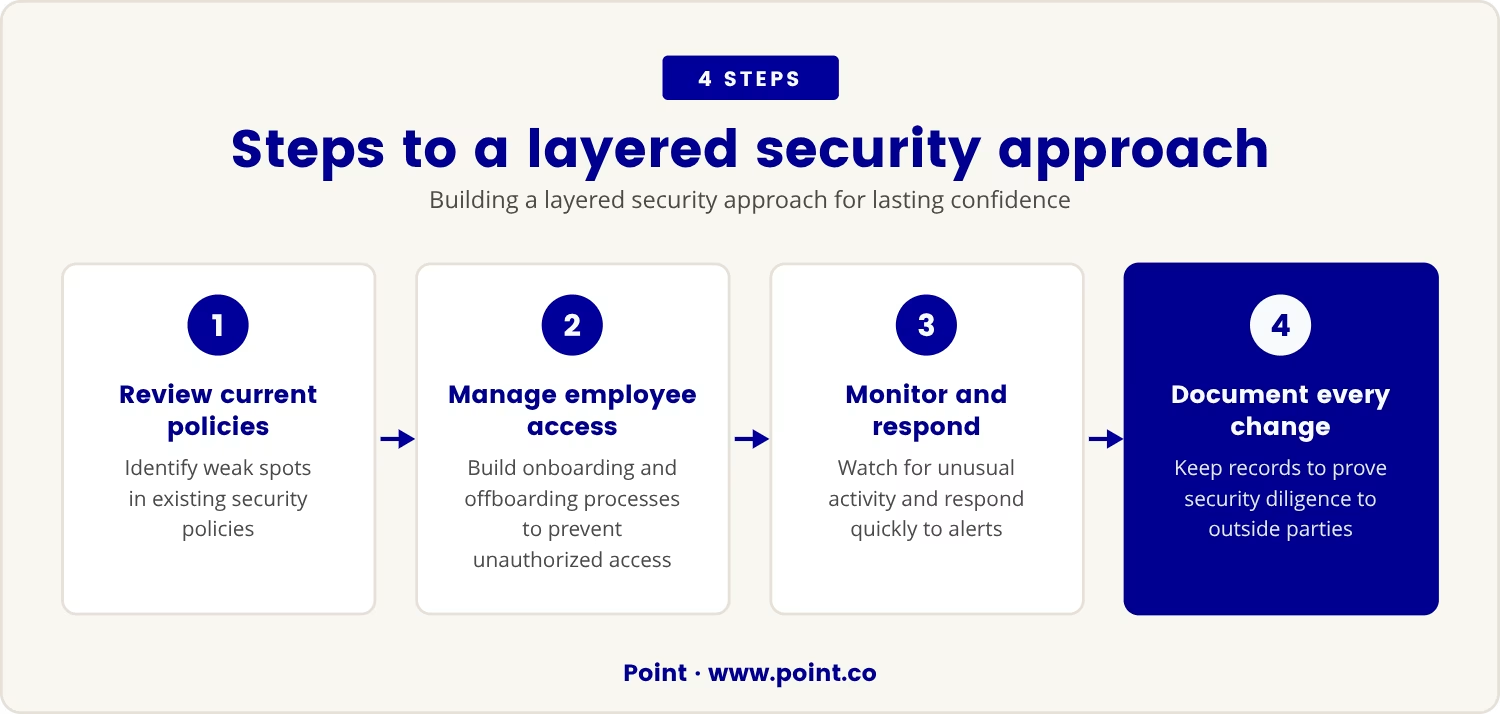
A strong credential policy is only one piece of the puzzle, so protecting your business and keeping growth plans on track calls for a layered security approach built around it.
Start by reviewing current policies to identify weak spots, then update password rules to require complexity and regular changes, adding multi-factor authentication wherever it's possible to do so.
From there, build clear processes for onboarding and offboarding employees, since that structure prevents unauthorized access and keeps records current. Monitoring systems for unusual activity, paired with a quick response to alerts, closes the loop.
Finally, document the policies themselves and keep a record of every change made, because that paper trail is what lets you show outside parties you take security seriously. When a due diligence review arrives, you'll already have the proof in hand.
A few consistent habits go a long way toward avoiding the hidden costs described above:
Beyond preventing breaches directly, these habits send a signal of their own, showing partners and investors that security is being taken seriously rather than treated as an afterthought.
A single weak credential policy can produce effects that reach far beyond the original problem, and even after a breach is fixed, the questions it raises can slow down your business's biggest opportunities.
So if growth, a merger, or a funding round is on the horizon, it's worth making sure your security measures are current now rather than later. The time spent on that today can save far more time down the road.

At Point , we understand that organizations with 15 to 200 users—especially those scaling past 40—face unique challenges when it comes to cybersecurity and growth. A single overlooked policy can slow down your biggest plans, even after technical issues are resolved.
If you want to see how we approach credential management and prepare businesses for smooth funding or merger reviews, let’s start a conversation about your current setup.
Qualifying businesses can receive up to $5,000 in free network upgrades to help address hidden vulnerabilities before they become roadblocks.
Check that your password requirements call for complexity, regular updates, and multi-factor authentication on sensitive systems, and confirm there's a clear process for cutting off access when employees leave. Having these measures documented in writing puts you in a strong position for most due diligence reviews.
Phishing attacks, ransomware, and malware delivered through email or fake websites are the most frequent threats small businesses face. Attackers often target smaller companies precisely because they expect fewer defenses, looking for easy entry points like weak passwords or outdated software that regular training and system updates can close off.
Investors want assurance that their money is safe and that the business won't run into unexpected risk after the deal closes. Weak cybersecurity practices can lead to breaches, legal exposure, and reputational damage, so reviewing your policies lets investors judge whether you're prepared to handle threats and protect sensitive data.
Reviewing the policy at least once a year is a reasonable baseline, with additional reviews whenever the business changes significantly, such as adding new systems or growing the team. Regular updates keep pace with new threats and demonstrate to partners that security is an ongoing priority rather than a one-time fix.
Address it immediately by updating the policy to require stronger passwords and adding multi-factor authentication where it's missing. Communicate the change to the team, provide training if needed, and document the update so it can be shown to partners or investors as evidence the vulnerability was addressed.